Many businesses believe they’ve done a proper Google My Business audit — yet their local rankings continue to drop.
In most cases, the problem isn’t what they checked, but what they overlooked.
This article covers the most common GMB audit mistakes that silently hurt local rankings and explains how to fix them correctly, based on real-world local SEO behavior.
If you’re not sure how to properly review your listing, it’s important to first understand the complete process. You can follow this step-by-step guide to audit your Google Business Profile before fixing these mistakes.
Table of Contents
Mistake #1: Assuming Verification Means Optimization
One of the biggest misconceptions is:
“My business is verified, so everything is fine.”
Why this hurts rankings
Verification only confirms ownership. It does not:
- Optimize relevance
- Improve prominence
- Fix category or content issues
What to do instead
After verification:
- Review every profile section manually
- Compare with top-ranking competitors
- Update weak or missing information
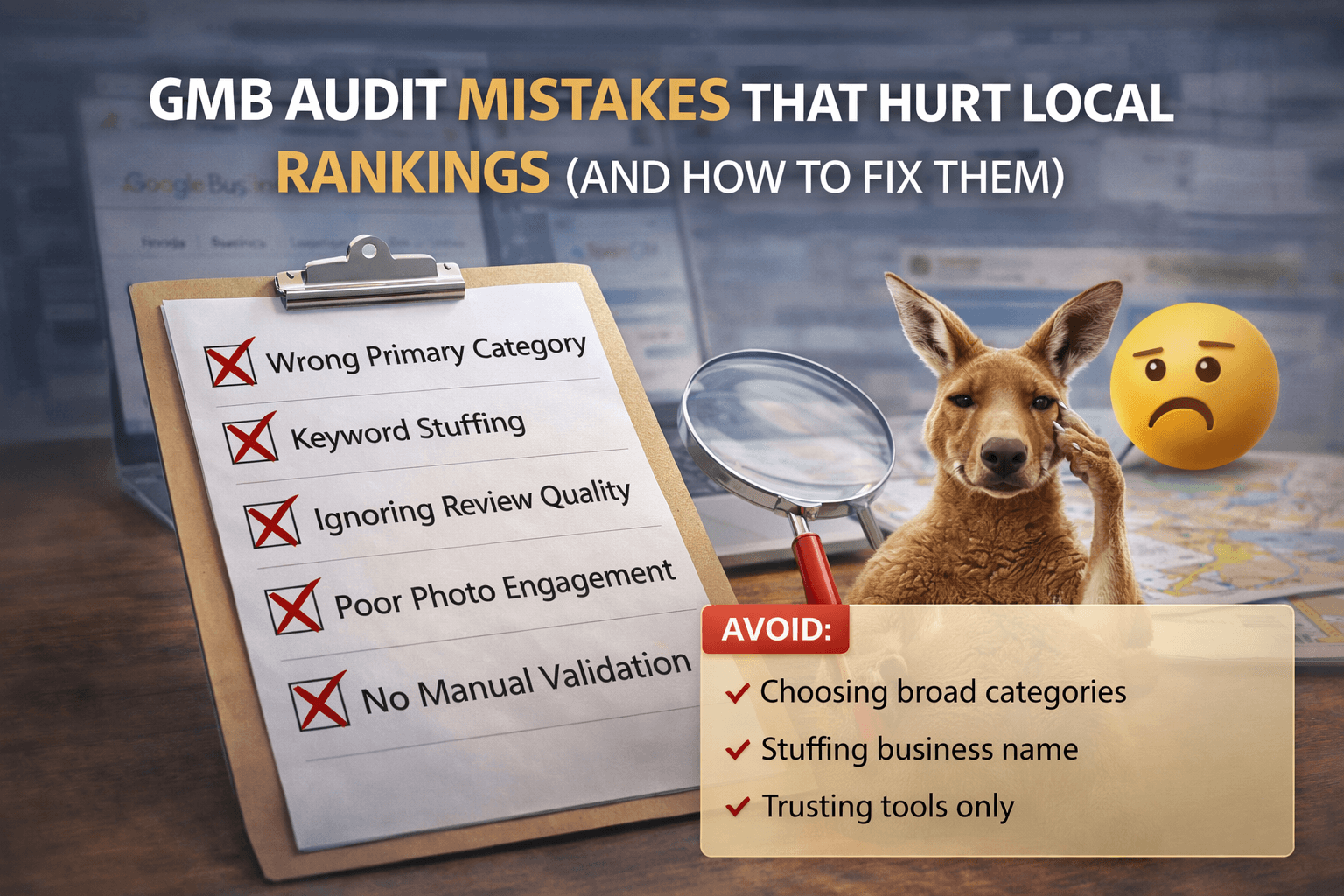
Mistake #2: Choosing the Wrong Primary Category
Many audits fail at the category level.
Common errors
- Selecting a broad category
- Copying categories without competitor research
- Changing categories too frequently
Why it matters
Your primary category strongly affects:
- Discovery searches
- Map pack eligibility
- Ranking consistency
Fix
Manually check:
- Top 3 competitors for your main keyword
- Their primary category
- Match intent — not exact wording
👉 Learn the manual process in this Google My Business audit step-by-step guide for beginners.
Mistake #3: Placing Keywords in your business Name or Description
Some audits still recommend adding keywords everywhere.
Why this is risky
- Violates Google guidelines
- Can trigger suspensions
- Reduces long-term trust
Better approach
- Keep business name real
- Write descriptions for users, not bots
- Use services and locations naturally
Subtle relevance always beats forced optimization.
Before fixing these issues, it’s a good idea to quickly review your listing using a Google My Business audit checklist to identify missing elements.
Mistake #4: Ignoring Review Quality During Audits
Counting reviews is not the same as auditing reviews.
What audits often miss
- Review freshness
- Review content relevance
- Business response patterns
Why this hurts rankings
Reviews influence prominence, not just trust.
Fix
- Encourage detailed, service-based reviews
- Reply to every review professionally
- Address negatives calmly and clearly
Mistake #5: Overlooking Photo Engagement Signals
Many audits only check whether photos exist.
The real issue
Google tracks:
- Photo views
- Upload frequency
- User interaction
Fix
- Upload real, recent photos
- Add interior, exterior, and work images
- Update monthly, not once a year
Photos are engagement signals, not decoration.
Mistake #6: Trusting Tools Without Manual Validation
Tools are helpful — but incomplete.
Why this is dangerous
- Tools miss context
- They don’t see competitor behavior
- They can’t judge intent
Fix
Always combine tools with:
- Manual searches
- Competitor comparisons
- Real-user perspective
👉 For hands-on checks, follow this manual Google My Business audit guide.
Mistake #7: Not Monitoring Sudden Ranking Drops
Many audits are one-time tasks.
Why this fails
Local rankings are dynamic. Changes happen due to:
- Algorithm updates
- Competitor actions
- Profile edits
Fix
- Audit regularly
- Track Insights manually
- Investigate sudden drops immediately
According to Google’s official local ranking factors, relevance, distance, and prominence determine local visibility — all of which can change over time.
How This Article Supports Your Content Cluster
- Checklist: What to check
- Step-by-step: How beginners should approach it
- Manual audit: How to execute without tools
- This article: What mistakes to avoid
- Pillar: Why all of this impacts rankings
Together, these articles strengthen topical authority and reduce ranking volatility.
To avoid these mistakes in the future, make sure you follow a complete audit process and use a structured checklist regularly.
Final Thoughts
Most local ranking issues are not caused by missing data —
they’re caused by incorrect assumptions during audits.
Avoiding these GMB audit mistakes helps you:
- Protect rankings
- Improve trust
- Build long-term local visibility
👉 For a complete strategic overview, revisit the Think Local SEO Google My Business audit guide.