If your business is not showing up on Google Maps or local search results, chances are your Google Business Profile is not properly optimized. Many businesses create a listing but never audit it — and that’s where they lose visibility, leads, and customers.
That’s where Think Local Google My Business Audits come in.
In this guide, you’ll learn exactly how to audit your Google Business Profile step by step, fix hidden issues, and improve your local SEO performance. Whether you’re a beginner or managing multiple listings, this guide will help you take full control of your local rankings.
Table of Contents
What are Think Local Google My Business Audits?
A Think Local Google My Business audit is the process of carefully reviewing and optimizing your Google Business Profile to make sure it is fully aligned with local SEO best practices. It’s not just about checking whether your business is listed — it’s about ensuring every detail is accurate, complete, and working in your favor to improve visibility in local search results.
When people search for services “near me” or within a specific location, Google relies heavily on business listings to decide what to show. If your profile is incomplete, outdated, or inconsistent, your chances of ranking drop significantly. That’s why regular audits are essential — they help you identify gaps, fix errors, and strengthen your overall local presence.
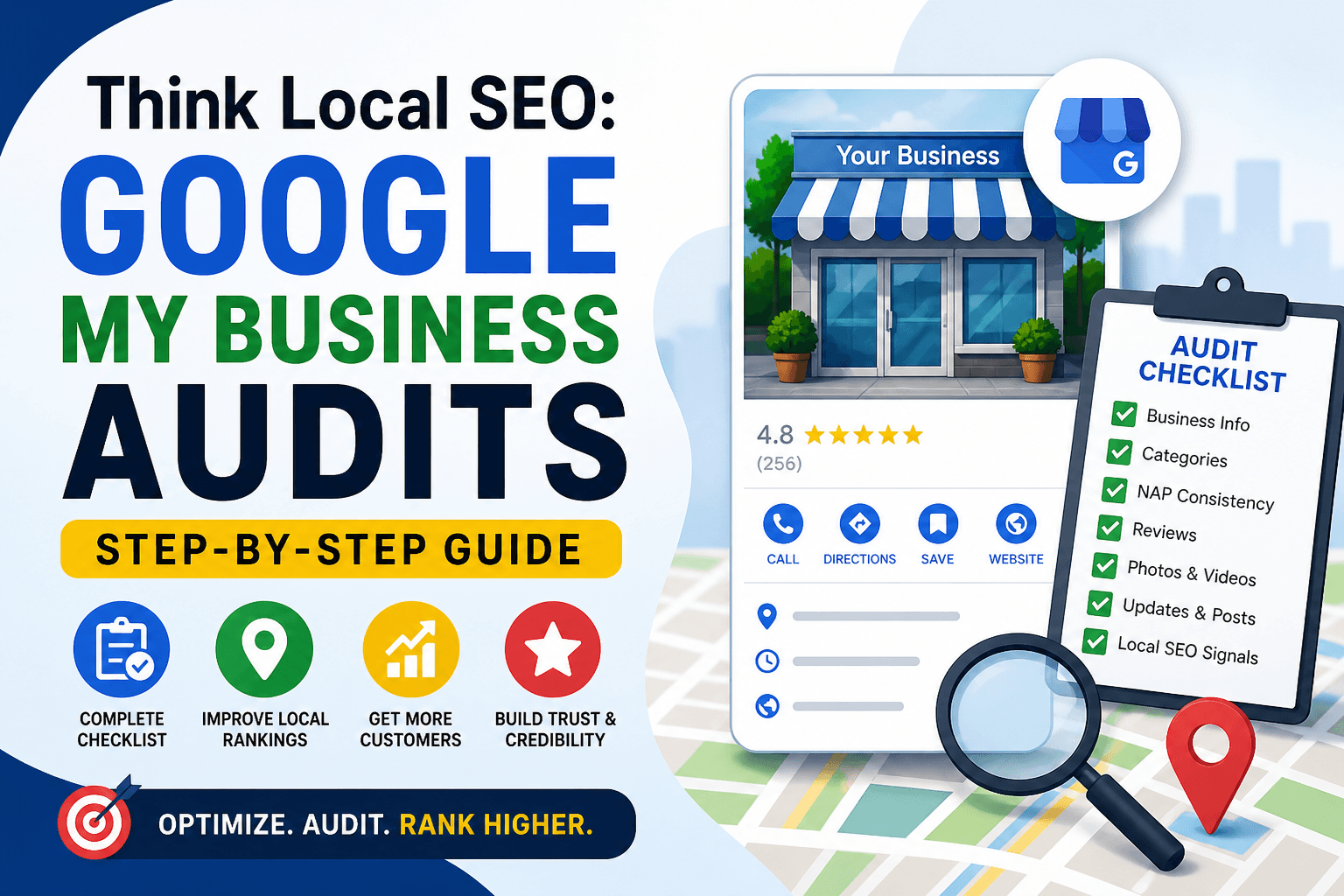
A proper audit typically includes reviewing:
- Business information accuracy (name, category, contact details)
- Reviews and ratings (quality, quantity, and responses)
- Photos, updates, and activity levels
- Local SEO signals (keywords, relevance, and consistency across platforms)
What makes this process important is that small improvements can lead to big results. For example, updating your business category or responding to customer reviews can directly impact your rankings and customer trust.
👉 Think of it like a health check-up for your local presence — it helps you find hidden issues, improve performance, and stay competitive in your area.
Why This Matters
If you’re not regularly auditing your Google Business Profile, you’re likely missing out on valuable visibility and potential customers. Many businesses assume that simply creating a listing is enough, but in reality, ongoing optimization is what drives results in local SEO.
Google constantly evaluates business listings based on accuracy, activity, and relevance. If your profile is outdated, incomplete, or inactive, it signals to Google that your business may not be reliable — which can push you lower in local search results.
Many businesses unknowingly make common GMB audit mistakes that can hurt their local rankings.
Here’s why audits are so important:
- Improves visibility in Google Maps:
A well-optimized profile has a much higher chance of appearing in the local 3-pack (top map results), which gets the majority of clicks. - Increases calls, visits, and leads:
When your listing is complete and engaging, users are more likely to call, visit your website, or get directions. - Builds trust with customers:
Accurate information, updated photos, and active review responses create a strong first impression and build credibility. - Fixes hidden SEO issues:
Small errors like wrong categories, inconsistent NAP details, or missing updates can quietly hurt your rankings — audits help you catch and fix these issues.
💡 In our experience, even minor improvements — such as updating your business category, adding fresh photos, or responding to reviews — can lead to noticeable improvements in local rankings and user engagement.
How We Reviewed This Process
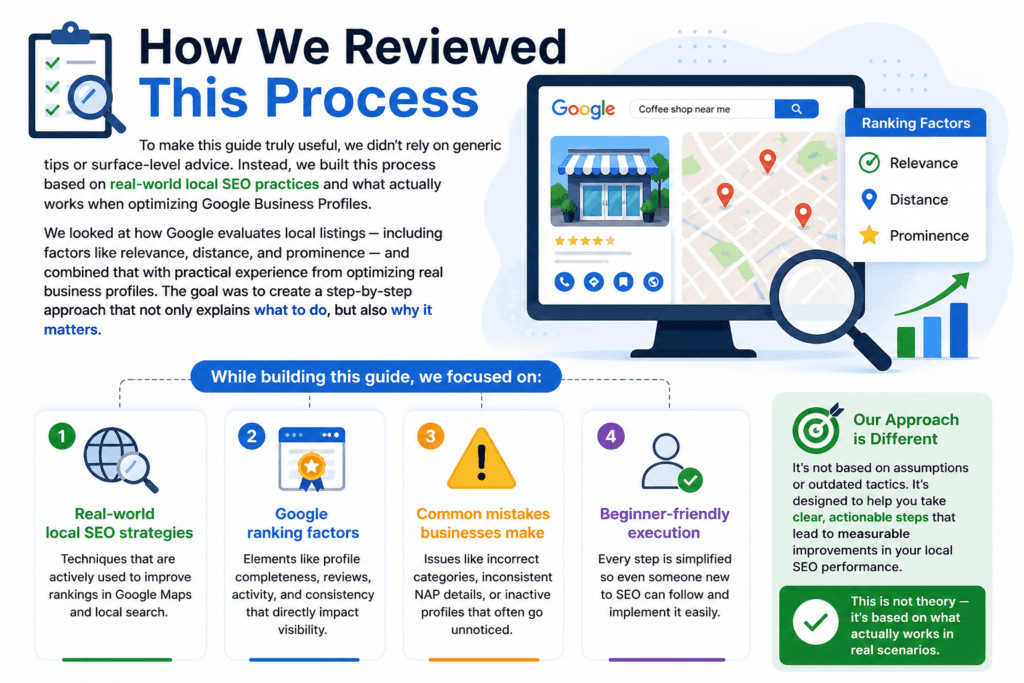
To make this guide truly useful, we didn’t rely on generic tips or surface-level advice. Instead, we built this process based on real-world local SEO practices and what actually works when optimizing Google Business Profiles.
We looked at how Google evaluates local listings — including factors like relevance, distance, and prominence — and combined that with practical experience from optimizing real business profiles. The goal was to create a step-by-step approach that not only explains what to do, but also why it matters.
While building this guide, we focused on:
- Real-world local SEO strategies:
Techniques that are actively used to improve rankings in Google Maps and local search. - Google ranking factors:
Elements like profile completeness, reviews, activity, and consistency that directly impact visibility. - Common mistakes businesses make:
Issues like incorrect categories, inconsistent NAP details, or inactive profiles that often go unnoticed. - Beginner-friendly execution:
Every step is simplified so even someone new to SEO can follow and implement it easily.
What makes this approach different is that it’s not based on assumptions or outdated tactics. It’s designed to help you take clear, actionable steps that lead to measurable improvements in your local SEO performance.
👉 This is not theory — it’s based on what actually works in real scenarios.
Quick Audit Checklist Overview
| Area | What to Check | Importance |
| Profile Info | Name, category, description | High |
| NAP Consistency | Address & phone accuracy | High |
| Reviews | Quantity & responses | Very High |
| Photos | Quality & frequency | Medium |
| SEO Signals | Keywords & local relevance | High |
Step-by-Step Google My Business Audit
Auditing your Google Business Profile doesn’t have to be complicated. When you break it down into clear, manageable steps, it becomes a simple process of identifying gaps and improving each part of your listing. The goal is to ensure that your profile is complete, accurate, and aligned with what Google expects for strong local rankings.
In the following steps, we’ll walk through each key area of your profile — from basic information and reviews to local SEO signals. By following this structured approach, you’ll be able to systematically improve your listing and build a stronger presence in Google Maps and local search results.
To make this process easier, you can follow a Google My Business audit checklist to ensure nothing is missed.
Step 1: Profile Completeness – Best for Basic Optimization
Your business profile must be 100% complete. Incomplete profiles struggle to rank.
What makes this step important is that Google prefers listings that provide full and accurate information to users.
Make sure your:
- Business name is correct
- Categories are properly selected
- Description includes relevant keywords
However, avoid keyword stuffing — it can hurt your ranking instead of helping.
Key Features:
- Complete business info
- Accurate categories
- Optimized description
👉 Best for: Beginners and small business owners
Step 2: NAP Consistency – Best for Trust Signals
Name, Address, and Phone Number is what NAP stands for.
One of the most undervalued elements is this. If your business information is inconsistent across platforms, Google gets confused.
What makes this important is consistency across:
- Website
- Directories
- Social media
Even small variations can affect your local SEO.
Key Features:
- Consistent business info
- Accurate contact details
- Improved trust signals
👉 Best for: Local businesses and service providers
Step 3: Reviews & Ratings – Ideal for Increasing Rankings
Reviews are a major ranking factor in local SEO.
What makes reviews stand out is their direct impact on:
- Rankings
- Customer trust
- Click-through rate
In our experience, responding to reviews regularly can significantly improve engagement.
However, fake or spam reviews can harm your credibility.
Key Features:
- Review management
- Response strategy
- Rating improvement
👉 Best for: Businesses wanting more visibility and trust
Step 4: Photos & Updates – Best for Engagement
Active profiles perform better.
Adding photos and posting updates tells Google that your business is active and relevant.
What makes this different is its impact on user behavior — profiles with photos get more clicks.
However, low-quality images can reduce trust.
Key Features:
- Image optimization
- Regular updates
- Better engagement
👉 Best for: Increasing user interaction
Step 5: Local SEO Signals – Best for Ranking Growth
This is where real SEO happens.
You need to optimize:
- Keywords in description
- Location relevance
- Website SEO
What makes this powerful is the combination of on-page SEO + local signals.
However, this requires consistency and ongoing effort.
Key Features:
- Keyword optimization
- Local relevance
- Website integration
👉 Best for: Long-term ranking improvement
Best by Use Case
Not all businesses require the same kind of optimization. The way you approach a Think Local Google My Business audit should depend on your experience, goals, and the size of your business. By focusing on the right areas, you can get better results without wasting time on unnecessary steps.
🟢 Beginners
If you’re just getting started, your main focus should be on profile completeness and using a checklist. Make sure all your business details are accurate, categories are properly selected, and basic elements like photos and descriptions are in place. At this stage, keeping things simple and consistent is more important than advanced optimization.
🟡 Small Businesses
For local businesses, the biggest impact comes from reviews and NAP consistency (Name, Address, Phone). These directly influence trust and local rankings. Actively collecting customer reviews and ensuring your business information is consistent across all platforms can significantly improve your visibility in Google Maps.
🔵 Bloggers
If you’re a blogger or content creator, you should focus on combining your Google Business Profile with your website SEO. This means linking your profile to well-optimized content, using local keywords, and building topical authority through your blog. This approach helps strengthen both your website and your local presence.
🟣 Agencies
For agencies or professionals managing multiple clients, a complete audit process combined with SEO tools is essential. This includes deep analysis, competitor tracking, regular updates, and performance monitoring. Agencies should aim for a structured, repeatable system that can be applied across different businesses for consistent results.
👉 By choosing the right approach based on your use case, you can make your audit process more effective and aligned with your specific goals.
How It Works
A Google My Business audit works by identifying gaps in your listing and fixing them step by step.
Process:
- Analyze your profile
- Identify missing elements
- Fix inconsistencies
- Improve engagement signals
- Monitor performance
👉For optimal results, repeat this step frequently.
You should also understand how often you should audit your Google Business Profile to maintain consistent performance.
FAQs
What is Think Local Google My Business Audits?
It is the process of reviewing and optimizing your business listing to improve local search rankings.
How often should I audit my listing?
At least once a month to keep your profile updated and competitive.
Why is my business not ranking on Google Maps?
Common reasons include incomplete profile, low reviews, and weak SEO signals.
Are reviews really important?
Yes, reviews directly impact rankings and customer trust.
Can I audit my listing without tools?
Yes, manual audits are possible using a checklist and proper strategy.
Conclusion
A proper Think Local Google My Business audit isn’t just a good practice—it’s a critical part of staying visible in local search and consistently attracting new customers. Simply creating a profile is not enough; ongoing optimization is what helps you compete and rank in Google Maps.
Start by fixing the basics—accurate business information, correct categories, and consistent NAP details. By following a structured audit process and reviewing your profile regularly, you can identify weak points and turn them into opportunities for growth.
Over time, these small improvements add up. Better visibility leads to more clicks, more calls, and ultimately more conversions. Consistency is crucial- businesses that actively maintain and update their profiles typically perform better than those that set them once and forget about them.
👉 If you’re serious about growing your local presence, make audits a regular habit. The sooner you start, the faster you’ll see results—because your competitors are already optimizing theirs.